Share Icon Health Study Area: Cardiovascular Disease Chevron Icon Health Study Area: Genitourinary For Patients Health Study Area: Lung Cancer Page Icon Phone Icon For Caregivers Health Study Area: AutoImmune Disease Health Study Area: Melanoma Location Icon Print YouTube Icon For Parents Health Study Area: Lung Cancer Print Created with Sketch. Help Icon Green Check Icon Search Icon Instagram Created with sketchtool. Direction Arrow Icon Error Icon For Parents Health Study Area: Blood Cancer Help Icon Health Study Area: NASH Gender Both Bookmark Icon Health Study Area: Melanoma Created with Sketch. Glossary Print Health Study Area: Blood Cancer Health Study Area: Genitourinary Health Study Area: Gastrointestinal Cancer Mobile Menu Icon Created with Sketch. Health Study Area: Cardiovascular Disease Health Study Area: Women's Cancer Communities Map Icon Created with Sketch. For Caregivers Health Study Area: Fibrosis Health Study Area: AutoImmune Disease FAQs Health Study Area: Head and Neck Cancer Created with Sketch. For Clinicians Chevron Right Icon Gender Female Health Study Area: Breast Cancer Direction Arrow Icon Gender Both Right Arrow Icon LinkedIn Icon Green Check Icon Gender Male Health Study Area: Fibrosis For Patients Twitter Icon Email Icon Facebook Icon Health Study Area: Gastrointestinal Cancer Health Study Area: Head and Neck Cancer For Clinicians External Link Icon

Arlo-cel MOA

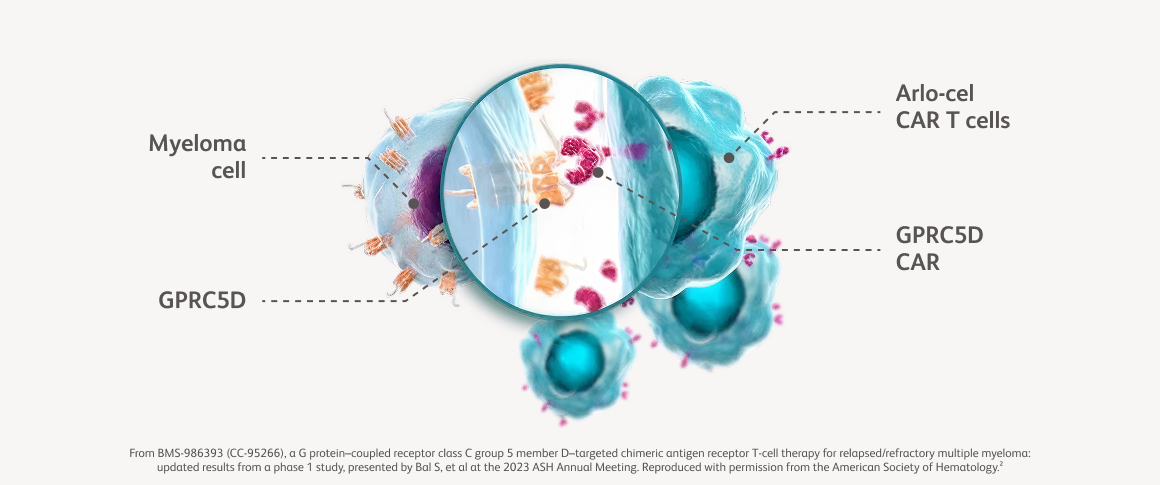
Arlocabtagene autoleucel (arlo-cel) is an investigational GPRC5D-directed autologous CAR T cell therapy.1

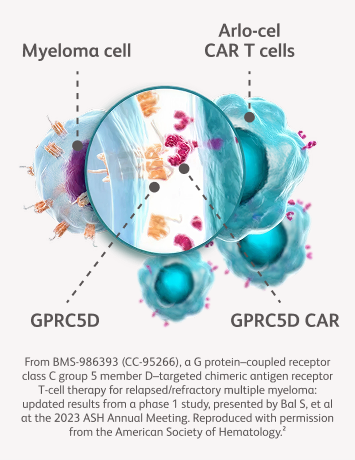
Mechanism of action (MOA) of arlocabtagene autoleucel (arlo-cel) in the QUINTESSENTIAL clinical trials Mechanism of action (MOA) of arlocabtagene autoleucel (arlo-cel) in the QUINTESSENTIAL clinical trials

Investigational arlo-cel is designed to recognize and bind to GPRC5D expressed on multiple
myeloma cells, to target and eliminate GPRC5D-expressing myeloma cells.1,3

Arlo-cel binding to GPRC5D-expressing cells

Arlo-cel binds to GPRC5D-expressing cells.

CAR T cells proliferating

CAR T cells proliferate

CAR T cells secreting cytokines

and secrete cytokines.

Cytolytic destruction of multiple myeloma cells

Cytolytic destruction of multiple myeloma cells occurs.

See how investigational arlo-cel is designed to work

GPRC5D as a therapeutic target in multiple myeloma

GPRC5D is a validated therapeutic target in multiple myeloma. Its expression is independent of BCMA expression and is maintained even after prior BCMA-directed therapy. GPRC5D is highly expressed on the surface of multiple myeloma cells, with limited expression on other immune cells and restricted expression in healthy tissues.3-5

Targeting GPRC5D may not be associated with B-cell depletion over time and further studies are needed to see if it may help preserve humoral immunity.4

Clinical Trials1,6,7

Clinical trials of arlo-cel are currently ongoing.

  • Trials include, but are not limited to, adult patients with RRMM exposed to lenalidomide
  • In the phase 3 trial, arlo-cel is being evaluated as a one-time infusion as part of a treatment process compared with standard-of-care regimens commonly used in RRMM*
Person with beaker

Arlo-cel is an investigational product being studied for the treatment of multiple myeloma and has not been approved for use in any country.

*Treatment process includes leukapheresis, manufacturing, bridging therapy, administration, and adverse event monitoring.

Explore Arlo-cel Clinical Trials ​

Arlo-cel phase 2 study7

Arlo-cel phase 3 study6,8

Magnifying glass with checkmark

Have a trial identified already?
Find a clinical trial by location​​

BCMA=B-cell maturation antigen; CAR=chimeric antigen receptor; DPd=daratumumab + pomalidomide + dexamethasone; GPRC5D=G protein-coupled receptor, class C, group 5, member D; Kd=carfilzomib + dexamethasone; MOA=mechanism of action; RRMM=relapsed/refractory multiple myeloma.

References: 1. Popat R, Larson SM, Varshavsky-Yanovsky A, et al. Trial in progress: QUINTESSENTIAL-2—a phase 3 study of arlocabtagene autoleucel versus standard of care in adult patients with relapsed and refractory multiple myeloma (RRMM) exposed to lenalidomide. Poster presented at: 2025 International Myeloma Society (IMS) Annual Meeting; September 17-20, 2025; Toronto, Canada. Poster PA-079. 2. Bal S, Htut M, Nadeem O, et al. BMS-986393 (CC-95266), a G protein-coupled receptor class C group 5 member D-targeted chimeric antigen receptor T-cell therapy for relapsed/refractory multiple myeloma: updated results from a phase 1 study. Presented at: 65th American Society of Hematology Annual Meeting & Exhibition; December 9-12, 2023; San Diego, California. Presentation #219. 3. Smith EL, Harrington K, Staehr M, et al. GPRC5D is a target for the immunotherapy of multiple myeloma with rationally designed CAR T cells. Sci Transl Med. 2019;11(485):eaau7746. doi:10.1126/scitranslmed.aau7746 4. Pillarisetti K, Edavettal S, Mendonça M, et al. A T-cell-redirecting bispecific G-protein-coupled receptor class 5 member D x CD3 antibody to treat multiple myeloma. Blood. 2020;135(15):1232-1243. doi:10.1182/blood.2019003342 5. Rodriguez-Otero P, van de Donk NWCJ, Pillarisetti K, et al. GPRC5D as a novel target for the treatment of multiple myeloma: a narrative review. Blood Cancer J. 2024;14(1):24. doi:10.1038/s41408-023-00966-9 6. A study to compare the efficacy and safety of BMS-986393 versus standard regimens in adult participants with relapsed or refractory and lenalidomide-exposed multiple myeloma (QUINTESSENTIAL-2). ClinicalTrials.gov identifier: NCT06615479. Updated February 10, 2026. Accessed February 13, 2026. https://clinicaltrials.gov/study/NCT06615479 7. Study of arlocabtagene autoleucel (BMS-986393) a GPRC5D-directed CAR T cell therapy in adult participants with relapsed or refractory multiple myeloma (QUINTESSENTIAL). ClinicalTrials.gov identifier: NCT06297226. Updated February 10, 2026. Accessed February 13, 2026. https://clinicaltrials.gov/study/NCT06297226 8. Popat R, Larson SM, Varshavsky-Yanovsky A, et al. QUINTESSENTIAL-2: a phase 3 study comparing efficacy and safety of arlocabtagene autoleucel (arlo-cel) versus standard regimens in adult patients with relapsed or refractory multiple myeloma (RRMM) refractory to lenalidomide. J Clin Oncol. 2025;43(16)(suppl):TPS7564. doi:10.1200/JCO.2025.43.16_suppl.TPS7564